 Storyclover
Storyclover
Storyclover
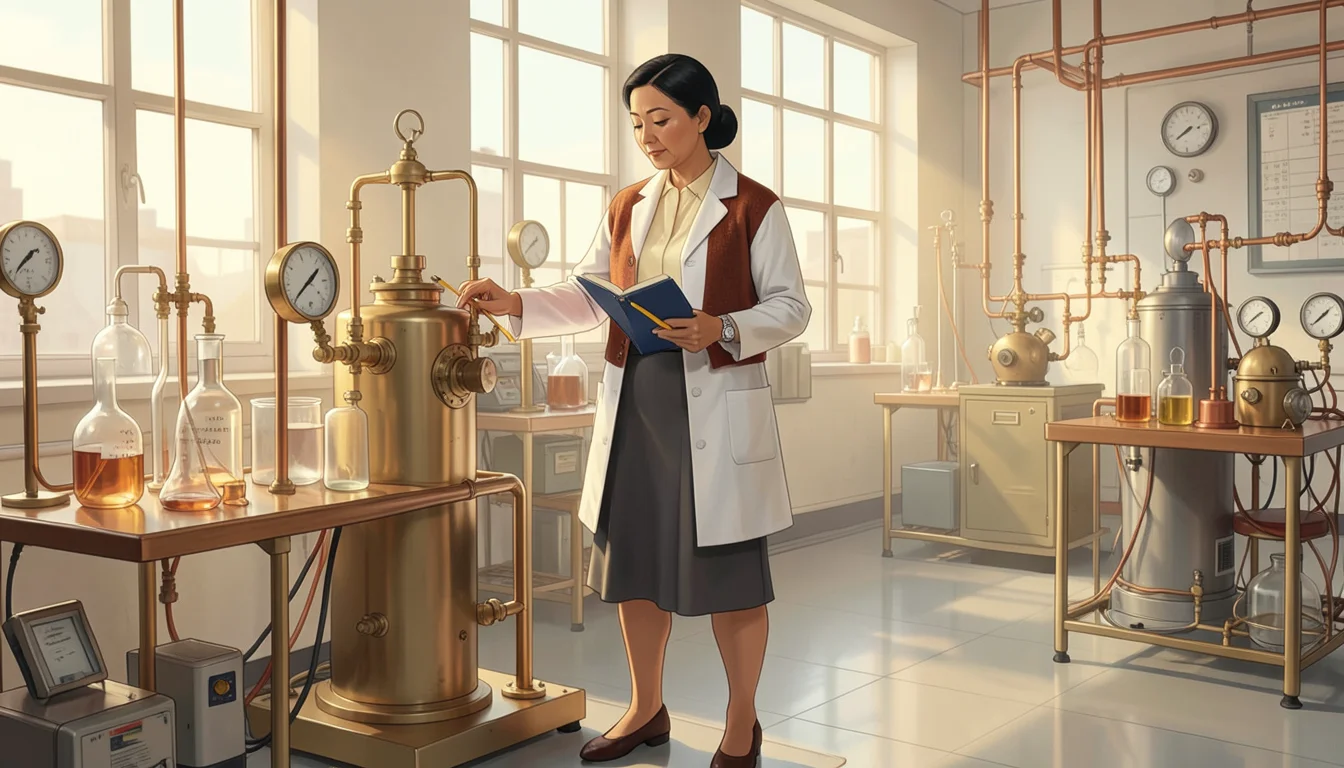
In the early morning at Columbia University, Chien-Shiung Wu tightened a small brass dial and watched a needle settle. She was preparing to test a rule that physicists had trusted for years.
Chien-Shiung Wu Built the Experiment That Broke a RuleChien-Shiung Wu's careful experiment showed that a trusted law of symmetry failed in particle physics, while others received much of the public credit.
1. In the early morning at Columbia University, Chien-Shiung Wu tightened a small brass dial and watched a needle settle. She was preparing to test a rule that physicists had trusted for years.
2. The rule was called parity. It said that nature should behave the same way in a scene and its mirror image: left and right could trade places, and the laws would not care.
3. Then Tsung-Dao Lee and Chen Ning Yang asked an unsettling question. Perhaps parity worked for ordinary forces but failed inside the weak force, the quiet rule behind certain kinds of radioactive decay.
4. Wu did not settle the question with a clever argument. She chose an experiment that could make the two possibilities face each other.
5. She chilled cobalt-60 to a temperature only a little above absolute zero and used a magnetic field to line up its tiny nuclei. The colder and steadier the sample, the clearer its answer could be.
6. She placed detectors around the sample and checked every connection. A loose wire, a stray warmth, or a careless angle could imitate a discovery, so she made the setup earn her trust.
7. When the cobalt-60 nuclei decayed, the detectors did not balance. More beta particles flew one way than the mirrored way. At the scale of atoms, left and right were no longer twins.
8. Wu repeated the measurements, changed what could be changed, and checked the result against the controls. Each careful comparison pointed to the same strange answer: parity failed in the weak force.
9. Lee and Yang's prediction had found its test, and Wu's experiment had supplied the evidence. Her result changed what physicists believed about the smallest pieces of nature.
10. In 1957, the Nobel Prize in Physics went to Lee and Yang for the discovery of parity violation. Wu's name was not on the prize, even though her experiment had shown the world what the broken symmetry looked like.
11. The instruments went quiet, but Wu's result did not. Chien-Shiung Wu had built the experiment that broke a trusted rule, while much of the public credit went to the men who had proposed the question.
Make a story like this →