 Storyclover
Storyclover
Storyclover
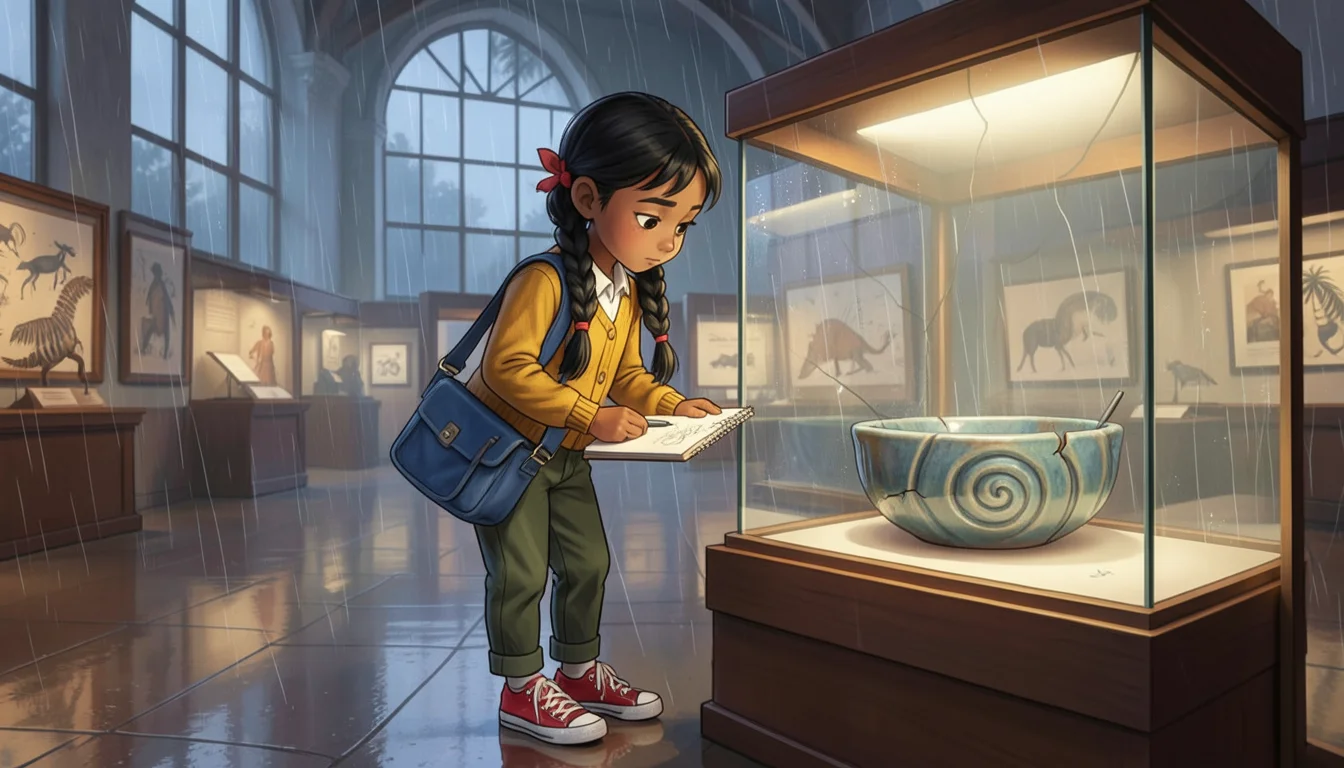
On a rainy Saturday morning, Amina copied the museum label into her sketchbook: “River-clay bowl. Maker unknown. Acquired 1912.” Her pencil hovered over maker unknown while the little bowl rested behind glass, shining as if it had kept a secret.
The Museum Label Could Not Fit the Whole StoryOne artifact in a museum leads to questions about who made it, who removed it, who explains it, and whether it should return home.
1. On a rainy Saturday morning, Amina copied the museum label into her sketchbook: “River-clay bowl. Maker unknown. Acquired 1912.” Her pencil hovered over maker unknown while the little bowl rested behind glass, shining as if it had kept a secret.
2. “Who wrote that?” Amina asked. Mr. Elias Reed knelt beside her and studied the bowl through the glass. “The label tells what the museum has been able to prove,” he said. “It does not tell everything the bowl has lived through.”
3. In an archive room, Amina found one clean fact. The accession file named a collector, Harlan Vale, and a place, Ketu River. It did not name the person who made the bowl. Amina drew a line beneath the empty space in her notebook.
4. Then Mr. Reed found a diary kept by Harlan Vale. One sentence changed the shape of the story: “Removed from a riverside house at Ketu River after the flood.” The word removed felt heavier than collected. It put a doorway, a house, and a person into the empty space.
5. Amina wanted to know what the museum could not. Mr. Reed helped her send the archive’s notes to the Ketu River community history center. The reply came from Mara Ndlovu, who offered to share a family account before anyone decided what the bowl meant.
6. Mara’s recorded voice carried the first name into the museum. The bowl was made by Sela Ndlovu, her great-grandmother, who shaped the three spirals to remember the bends of the Ketu River. Sela had made it for a ceremony held beside the water.
7. Mara’s account did not settle every fact. Her family remembered that Vale entered the storehouse while people had fled the flood and took the bowl without permission. Vale’s diary said he had bought it from a frightened household. For one hundred and twelve years, the museum had preserved only his version.
8. Mara did not ask them to choose a prettier story. She asked the museum to ask Ketu River what should happen next. The bowl might return, remain in shared care, or follow another path chosen together. Amina wanted to circle return, but left her pencil hovering.
9. The museum replaced its single sentence with a fuller account. It named Sela Ndlovu, Ketu River, Vale’s removal, and Mara’s explanation. It also admitted that the next decision did not belong to the museum alone. Amina read the new label twice, and neither time did it feel finished.
10. By closing time, the bowl had not moved. The museum had learned to leave room beside its label for the questions Amina carried out with her: Who made it? Who removed it? Who explains it now? And should it return home?
Make a story like this →