 Storyclover
Storyclover
Storyclover
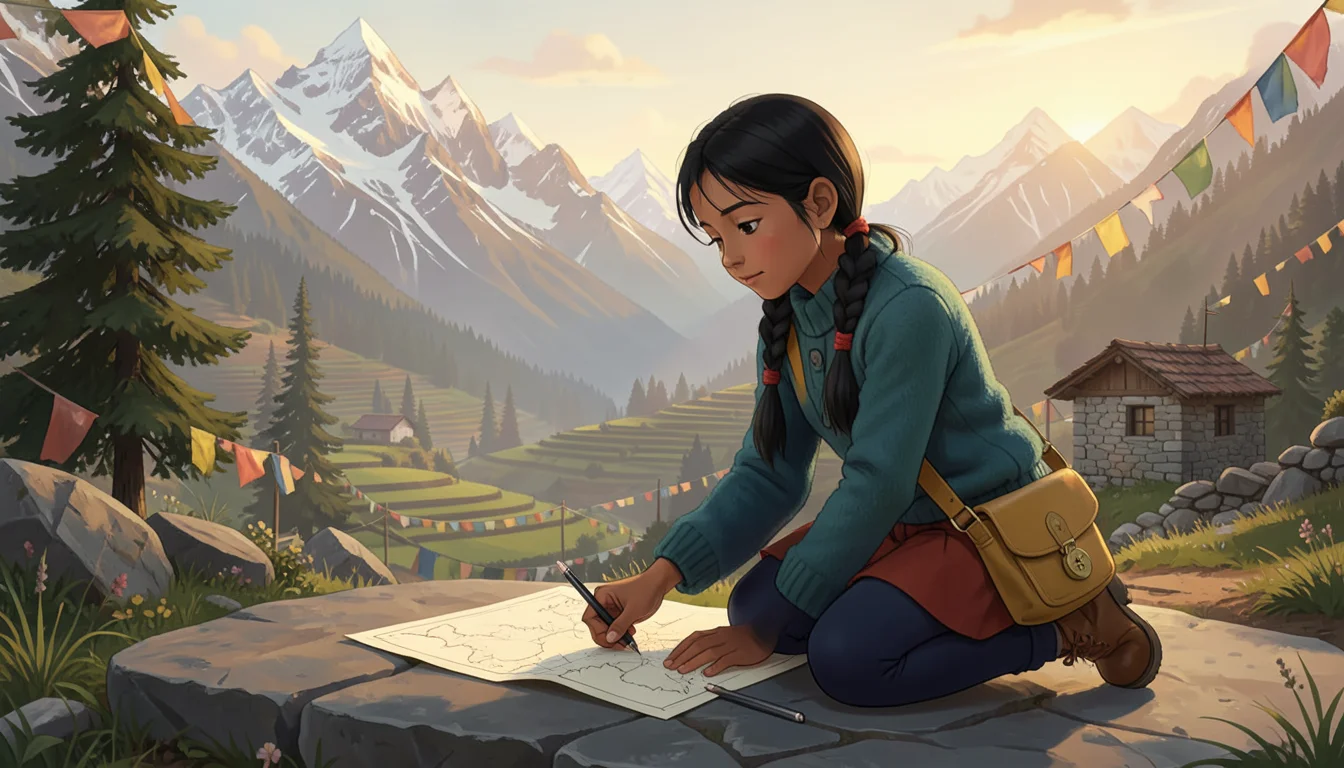
At first light, Tashi Gurung knelt beside the village spring and drew the valley as carefully as she could. She marked the footpaths, the bridges, the fields, and every house with a red roof.
The Mapmaker Who Had to Leave Half the Village BlankA young mapmaker in a Himalayan valley learns that some places are protected by silence, memory, and trust rather than by labels on a page.
1. At first light, Tashi Gurung knelt beside the village spring and drew the valley as carefully as she could. She marked the footpaths, the bridges, the fields, and every house with a red roof.
2. The map was for the district archive, and Tashi wanted it to be the finest map anyone had made of their valley. Sonam Ama studied the paper, then rested one finger on the empty half. “What is there?” Tashi asked.
3. Sonam Ama covered the paper with her hand. “There are old paths, a spring, and a grove of blue junipers,” she said. “But we do not put them on public maps.” Tashi looked at the blank space. It seemed larger than the whole valley.
4. Sonam Ama took Tashi beyond the last terrace. The path slipped between rocks and vanished beneath the junipers. At the end, a spring whispered into a stone basin, though no mark announced it.
5. Pemba, Sonam Ama’s grandson, showed Tashi where he and his cousins gathered berries. He knew which stones were loose and which ones had held their shape for a hundred winters. Tashi drew the stream, but she left the grove unnamed.
6. That evening, Tashi showed the village council what she had drawn. The map held nearly everything: the school, the yak trail, the old bridge, and the cliff where swallows nested. Only the western half remained white.
7. Tashi could have filled the space with a dotted trail and a small blue spring. A map with no blank places felt unfinished. She sharpened her pencil instead and listened to the wind move along the roof.
8. The next day, Rakesh Thapa arrived from the district office. He needed every spring and trail marked before winter. “People cannot use what they cannot find,” he said, tapping the blank half.
9. Rakesh asked Tashi to lead him there. She knew the path. She also knew that once it appeared on an official map, strangers could follow it without asking anyone’s name.
10. Sonam Ama opened a little wooden box. Inside lay a blue thread, a juniper seed, and a faded photograph of people gathered around the spring. “Our grandparents protected this place by telling its story only to those who would protect it,” she said.
11. Tashi told Rakesh what the map could not say: the spring was shared, the grove was fragile, and the path belonged to memory before it belonged to paper. Rakesh looked at the blank half for a long while.
12. Together, they made two maps. One showed the roads and water that everyone needed. The other stayed with the council, carrying memories that would be shared by trust, not by strangers following a line.
13. The finished map guided everyone to the places they needed. Its western half remained blank. Tashi no longer saw that space as a mistake; it held what the village had chosen to protect.
14. Tashi left the spring without a label. Some places were protected by silence, some by memory, and some by the trust passed from one careful hand to another. Not every true place needed a name on a page.
Make a story like this →